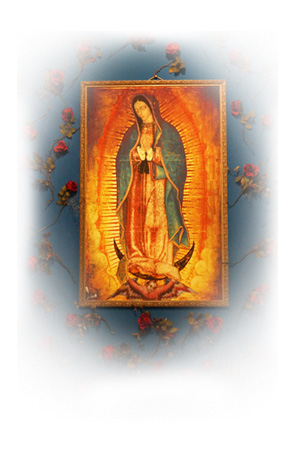
Medjugorje Message: August 25, 2025
Dear children, my little children, my beloved ones; you are chosen because you have responded, you have put into practice my instructions and love God above all else. Therefore, little children, pray with all your heart that my words may be realized. Fast, sacrifice yourselves, love out of love for God Who created you, and be, little children, my extended hands to this world that has not come to know the God of love. Thank you for having responded to my call.
River of Light
September 2025
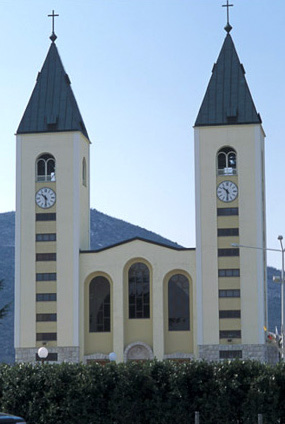 This month, Our Lady’s message uses the word “love” five times in four sentences. We can feel her overflowing affection for us in her unusual opening words, where she addresses us not simply as “Dear children” —her usual greeting—but by saying “Dear children, my little children, my beloved ones.” In this threefold salutation, can you feel the intense maternal gaze of Our Lady, looking tenderly upon all of us who are still—after 44 years—reading and listening to her monthly messages from Medjugorje? Can you sense the emotional depth, strong attachment, and powerful love she holds for us in speaking these endearing terms: “Dear children, MY little children, MY beloved ones“? By using the word “my,” Our Lady conveys that we are truly “hers,” that we belong to her in a very real way—and she elaborates on this “belonging” by saying: “you are chosen because you have responded, you have put into practice my instructions and love God above all else.”
Virtually every monthly message from Our Lady ends with the words, “Thank you for having responded to my call.” In its repetition we sometimes ignore or overlook it. But here Our Lady reveals just how profoundly significant is our “responding.” She tells us that we are “CHOSEN” because of our response. Indeed, in our Lord’s parable of the wedding banquet of heaven, he says, “Many are called, but few are chosen.” (Mt 22:14) These two movements—“CALL” and “RESPONSE”—are the key to both our present life and our eternal life. God-Who-Is-Love presents a universal CALL to every living creature without exception—ALL the living are “called” to join in the dance of Divine Love and Grace.
But the “chosen” are those who “respond to the call” by our wholehearted acceptance of the invitation; by faith in Love’s reality; and by living a transformed life of ongoing conversion in alignment with LOVE as the Divine Will. These two movements—“Call” and “Response”—reveal that our life is a continual two-way dialogue, exchange, relationship, and interplay between God’s grace and our human choice.
The moment-to-moment offer of LOVE from God can be seen and felt in a “zillion” ways as it permeates all life on planet Earth, keeping everything in existence; this is the “CALL” of Divine Grace upon every living being, regardless of circumstances. We “respond” to the call of this God-Who-Is-Love by our human choices. Those who are “chosen” are simply the ones who RESPOND TO LOVE WITH LOVE. To those, Our Lady says, “You have put into practice my instructions and love God above all else.”
Scripture tells us, “God is love.” (1 Jn 4:7), so to “love God above all else” means to “love LOVE above all else.” We must love LOVE with all our heart, mind, soul, and strength. (Dt 6:5, Mt 22:37, Mk 12:30)—the “Greatest Commandment,” from the Torah through the Gospels and New Testament. As we respond to the call of LOVE by our life lived in wholehearted love for all, we become “the Beloved Community,” as Martin Luther King, Jr. often preached. We are the chosen “beloved” (i.e. “dearly loved“) responders to God and Our Lady who daily “put into practice” the Gospel “instructions” by “loving God above all else.” While our efforts are always imperfect and often fail, Our Lady sees our heart which has “responded to her call.”
She continues: “Therefore, little children, pray with all your heart that my words may be realized.” What are her words? We may distill Our Lady’s words in Medjugorje to a simple message: PEACE, PRAYER, FASTING, CONVERSION, and SELF-EMPTYING. If these “words” of Our Lady, given repeatedly over the past 44 years, could be “realized,” we would live a new life on a new earth! We would experience “the Beloved Community” on a worldwide scale. It would be a community to which all belong and live in freedom, filled with merciful and forgiving “agape” love; where conflicts are resolved peacefully, without war or military power, but with justice, compassion, reconciliation, and restoration rather than retribution.
In “the Beloved Community“—continually transformed by LOVE—everyone would grow to see the image of God-Who-Is-Love in self, neighbor, and all creation, without prejudice or discrimination toward racial, ethnic, class, gender, educational, political or other differences. Inclusion, unity, peace, justice, and respect for the inherent value and dignity of each human person would define “the Beloved Community.” All would be “the Chosen.” This is the next evolutionary step for humankind if Our Lady’s “words are realized.”
That this vision of Our Lady may be realized and her “instructions put into practice,” she concludes her message by saying: “Fast, sacrifice yourselves, love out of love for God Who created you, and be, little children, my extended hands to this world that has not come to know the God of love.” The call to “fast” and “sacrifice yourselves” has always been a challenge for our weak human nature—especially in 21st century Western society where a cult of “ease and comfort” is our conditioning from birth.
But if we “respond” to the “call” of Our Lady and the Gospel and truly begin to “love out of love for God Who created us,” we will begin to find both “fasting” and “self-sacrifice” easier, and even joyful. For they are two key ways of living in alignment and conformity with God-Who-Is-Love—the cosmic Ultimate Reality which, even science now sees, operates through self-emptying love in a pattern of life-death-resurrection everywhere in the universe, from the quantum “micro-level” of atoms and molecules to the astronomical “macro-level” of quarks and black holes.
Our Lady urges us to “love out of love for God Who created you.” Herein lies the “rub” of our typical “romantic” loves, and the many other partial and self-interested forms of “love“ that we engage. Though we don’t realize or admit it, often these “loves” are grounded and inspired only by an egoic “love” of our own False Self, rather than a sacrificial, unconditional “agape” love for other persons. These selfish “loves” born of our unfulfilled needs are unmasked soon enough, when the relational versions of “fasting and self-sacrifice” come into play, and we find ourselves completely unprepared and unwilling to fulfill mature, adult, “true” Love’s demands.
In contrast, when we “love out of love for God,” we have a genuine care and concern for others that is disinterested in our own comfort, ease, and pleasure, but supremely interested in what is the highest and best blessing we can give to the ones we love. Again, we always fail to love “perfectly,” but even in sin and error, the intentions of our heart are seen and honored by Our Lady and Our Lord.
Finally, Our Lady repeats a phrase she has often spoken: “Be, little children, my extended hands to this world that has not come to know the God of love.” St. Francis of Assisi was known to weep copiously at times, with a broken heart crying out, “Love is not loved!…Love is not loved!” Indeed, as we look upon “this world” today, seeing the latest school shooting of Catholic children at Mass, relentless wars, violence, exploitation, greed, injustice, and the senseless cruelty of evil regimes near and far, we know that Our Lady is right. Despite all the teachings of the great religious traditions and spiritualities, whose mystical core points always to the One same LOVE, clearly our world has still “not come to know the God of love.”
Sadly, many are bound instead to a God of Law, God of Revenge, God of Judgment and Condemnation, or God of Absent Apathy. But in the “CALL” of the Annunciation from Gabriel, Our Lady heard and “RESPONDED” to GOD/LOVE. And in the Incarnation, Our Lady brought the eternal God-Who-Is-Love into human flesh and extended Him from her motherly arms to us, that we might finally know and understand LOVE as the Ultimate Reality we call “God.” This birthing, incarnating, and extending of Christ to the world through the hands of “responders” must be renewed in every age, so that our human species may survive and finally evolve to the next level—beyond our egoic prison of greedy materialism—to the God/Love consciousness that has no death or end.
+ + + + + + +
Empty yourself. Sit quietly, content with the grace of God.
—St. Romuald
The purpose of silence is to break through the crust of the false self.
—Fr. Thomas Keating, OCSO
If God is the center of your life, no words are necessary. Your mere presence will touch hearts.
—St. Vincent de Paul
It is better in prayer to have a heart without words than to have words without a heart.
—Mohandas K. Gandhi
Contemplation is a wordless resting in the presence of God beyond all thoughts and images.
—James Finley
+ + + + + + +
We cannot solve our problems with the same thinking that we used when we created them.
—Albert Einstein
Division begins in the MIND and can be ended by the HEART.
—Robb Smith
+ + + + + + +
Science can purify religion from error and superstition; religion can purify science from idolatry and false absolutes. Each can draw the other into a wider world, a world in which both can flourish.
—St. John Paul II
+ + + + + + +
“Incarnatio continua!”: The Incarnation continues IN you, AS you.
+ + + + + + +
Find inner peace and thousands around you will find salvation.
The purpose of the Christian life is the acquisition of the Holy Spirit.
—St. Seraphim of Sarov
+ + + + + + +
LOVE is the most universal, the most tremendous and the most mystical of cosmic forces. LOVE is the primal and universal psychic energy. LOVE is a sacred reserve of energy; it is the blood of spiritual evolution.
—Fr. Pierre Teilhard de Chardin
+ + + + + + +
Every being exists in intimate relation with other beings and in constant exchange of gifts with each other.
—Fr. Thomas Berry, CP
+ + + + + + +
Recognizing “enoughness” is a radical act in an economy that is always urging us to consume more.
—Robin Wall Kimmerer
+ + + + + + +
Our Amma/Abba, Divine Source-Who-Is-Love,
Whole and Holy is Your Name.
May Your reign of Love come, Your will of Love be done
Here on earth, just as it is with You.
You give us each day all that we need
and You hold no accounts against us,
just as we wish to hold no accounts against each other or ourselves.
Leave us not in temptation of believing the lie of separation,
But deliver us from its consequences of acting out in fear
and the evil delusions of ego.
For Yours is the power and the glory of endless Life, Light, and Love
now and forever, amen.
—Aramaic translation of the Lord’s Prayer
+ + + + + + +
Always there is something new to learn about how to progress in the love of God and one’s neighbor. How can we ever give up thinking and longing for love, talking of it, preparing ourselves for it, reading of it, and studying about it? Heaven and earth are linked together as the body and soul are linked together.
We begin to live again each morning. We rise from the dead, the sun rises, spring comes around—there is always that cycle of birth and growth and death, and then resurrection. And the great study of how to be made like God, to participate in the life of God. It is a painful study, and one can make it over and over again, and always we need to straighten our course, adjust ourselves to this Christian way which seems so often not natural. It is breathing rarified air; one must get used to this air of the mountains, so clear, cold, sharp, and fresh. It is like wine, and we have prayed to Mary and said, “We have no wine,” and she has given us wine, the body and blood of her Son, the life of her Son, the love of her Son.
What should really set us apart from all other people is our LOVE. “See how they love one another.” In the Bible, the relationship between God and man, the pleasures of the beatific union are described as those of a wedding banquet or an embrace. “He will kiss me with the kisses of his mouth.” (Sg 1:2) And we should have something like this love for all creatures—for mate, for friend, for child, for enemy too—the kind of love that makes all things new. How much there is to learn of love, that feeling of the body and soul, that teaches us what God is, that God is love.
—Servant of God Dorothy Day
+ + + + + + +
What gets in the way of becoming pure of heart? “The problem with the passions is that they divide the heart.” (The Philokalia) They are the culprit that takes from the heart its capacity to see with clarity, with luminosity and radiance, and makes it the slave of your personal drama. “Passio” means “I suffer. I am acted upon.” The passions are really stuck emotions, revolving around themselves to generate drama.
The 4th century spiritual teacher, Evagrius, said you have to learn to nip the thought in the bud before it becomes a passion. It’s a witnessing practice, developing the capacity to see, combined with kenosis, the willingness to let go of the satisfaction you get from your drama.
The core practice for cleansing the heart and restoring it to an organ of spiritual seeing, becomes supremely, in Christianity, the path of kenosis, of letting go. The real heart of working with emotion is the willingness to let go, to sacrifice your personal drama, so that you can begin to see with a pure heart.
—Rev. Cynthia Bourgeault
+ + + + + + +
Much of the work of emotional maturity is learning to distinguish between emotions that give us a helpful message about ourselves or situations, and emotions that are merely narcissistic reactions to the moment. Until we have found our spiritual center, most of our emotional responses are too self-referential to be truthful, for the small, defensive “I” cannot hold the space or be a reference point for objective truth.
When we try to shut down emotions (like fear, guilt, shame), they become more complex and conflicted—and less honest reflections of reality. If an emotion does not help us read the situation better and more truthfully, we must release it, let it move through us. Practicing this detachment is one of the great tasks of any healthy spirituality—fully feeling the emotion first, learning its message, then purposely detaching from it.
Pure consciousness is not compulsive identification and unquestioned attachment to our passing thoughts, feelings, and our isolated selves. Rather, it is observing “me” from the viewing platform offered by God which we call the Indwelling Spirit. This is having a proper distance from ourselves which, ironically, enables us to see our radical connectedness with everything else.
—Fr. Richard Rohr, OFM
+ + + + + + +
It is entirely possible that God will be with me here, within being.
That I will become more open to His presence.
For it is the greatest wish of the Lord that he be present within being
for all creatures at all times.
In His infinite generosity, it is not enough that He create everything
and that He give life to all creatures. He offers even more.
He offers Himself
to be here as a companion in love and in being.
I have a wish to let go of who I am
and discover this truth more deeply within being
so that I better sense the presence of the Lord
in each thing as it arises,
in each action, in each sound, in each blade of grass
that grows beneath my feet.
The softer I become and the less resistance I offer,
the more the connective tissue of the Holy Spirit
flows into this body through the new and magnifying stillness
that begins to spread itself throughout this body
like a blessing, and I remember now to say:
Lord, I call to thee from the depths of my iniquity.
I have not delivered myself sufficiently unto thee.
I know not how.
And the beginning of grace touches the soul here where I confess.
For it seeks me and would offer help.
So I come into a more intimate contact with it here.
I say yes. I have come to the threshold of where miracles begin.
—Lee Van Laer
+ + + + + + +
St. Teresa of Avila wrote: “All difficulties in prayer can be traced to one cause: praying as if God were absent.” This is the conviction we bring with us from early childhood and apply to everyday life and to our lives in general. It gets stronger as we grow up, unless we are touched by the Gospel and begin the spiritual journey. This journey is a process of dismantling the monumental illusion that God is distant or absent.
The spiritual journey, then, teaches us the following:
- To believe in the Divine Indwelling within us, fully present and energizing every level of our being.
- To recognize that this energy is benign, healing and transforming.
- To open to its gradual unfolding, step-by-step, both in prayer and action.
—Fr. Thomas Keating, OCSO
+ + + + + + +
Nothing in the Gospels suggests that Jesus was interested in creating a religion. He was offering everyone a chance for a peaceful and fulfilling life by adopting a different set of values. The crux is a shift from judgment, competition, and aggression to the rule of an open heart. The Gospels represent a movement out of narcissism and paranoia to a more mature, self-possessed life of deep community.
The Gospels do not focus on a plan for spiritual self-improvement and a virtuous personality. They offer a new way of imagining the human worldwide community. How do you live the Gospel spirit today? You do what the Gospel says:
Firstly, you cultivate a deep respect for people who are not of your circle and whom society rejects. Secondly, you do everything possible to deal effectively with demonic urges in yourself and in society. You live with a mindset that doesn’t justify aggression, paranoia, narcissism, greed, jealousy, and violence, but seeks alternatives. Thirdly, you play the role of healer in every situation. Finally, you stay awake and don’t fall into the unconsciousness of the age. You also help others wake up to a thoughtful life imagined in fresh ways.
If you follow the example of Jesus and listen for your destiny, you will have to go your own way, adapting the simple, radical teachings to your own calling and circumstances. You will evoke the kingdom in your own style, making your own life a tiny mustard seed, and yourself the embodiment of the moral beauty and spiritual intelligence found in the Gospels.
—Thomas Moore
+ + + + + + +
Fire speaks of purification, destruction, melding, forging. If fire symbolizes Jesus’s primary mission, then Christianity should exist in the tension between creative transformation and purification—welcoming the refining fire that consumes whatever obstructs love while building communities of profound compassion. Christian faith extends far beyond comfort or maintaining the status quo, encompassing instead the active process of transformation. Fire does not leave things unchanged. It either purifies precious metals, making them stronger and more beautiful, or it consumes what cannot withstand its heat.
Living in this space of creative love means Christians must constantly discern what needs to be preserved and what needs to be released. Authentic Christianity is neither static nor safe—it is the ongoing work of allowing the divine fire to shape both individuals and communities into something closer to the vision of a new earth and a new heaven.
Christianity began as a movement, but today evolution invites us to see Christianity IS movement—happening, becoming, as it journeys toward eschatalogical fulfillment. Christianity means being born again repeatedly; it is about ongoing transformation. Its main task is not doctrine, moral rightness, or belief in one true God. God is true wherever love exists, and love is expressed uniquely by each person. Each person is called to inner transformation, to continually renew our minds and hearts, to constantly strive to see the world and one another with new eyes.
To be a Christian is to fall in love over and over, enduring in love, suffering in love, and trusting that love will prevail through every storm, darkness, and destruction. Jesus’s message is simple: let go, let God, and trust the Spirit within. We must constantly ask if Christianity is deepening our humanity by firing up our hearts for a greater love. If love for another humanizes us, then Christianity will succeed when we become fully human. Then we will no longer have to talk about religion or God, for God will be all in all.
—Sr. Ilia Delio, OSF
+ + + + + + +
The skin of deeply spiritual persons is not a dividing membrane that separates them from the world—but a connecting membrane, a permeable membrane, through which events of the world and events of their inner life flow into one another.
—Patricia Mische, Toward a Global Spirituality
+ + + + + + +
What Merton saw was that the world will not survive religion based on in-group consciousness. It’ll bring the whole world down. But if those who have been awakened within their tradition to the Divine Mystery which also transcends their tradition, when they all come in toward that all-encompassing center, they recognize each other. And if they would speak up, religion’s awakening could be a source of world unity and peace. Merton was trying to be someone who spoke out of this unified clarity. He saw that each religion is like a different language of the universality of awakening.
—James Finley
+ + + + + + +
September 8: Nativity of the Blessed Virgin Mary
Mary is the full flowering of the grace of Jesus Christ. To know her is to know what he has accomplished, what his victory has won. She shows in a singular manner what all of us are called to become. She is the realization of all that God has promised us. The singular graces she received reveal what God intends to accomplish for all, desiring to make us full of grace, as she was.
In her becoming the Mother of God, we learn that God desires us to conceive him in our thoughts and bring him forth by our words and actions. Her virginity is fruitful because God intends our souls likewise to be pure and fruitful. God assumes her body and soul into heaven because he desires to raise our bodies to the same glory. In proclaiming Mary we make known not only Christ’s masterpiece of grace but also what he desires to accomplish in us.
—Fr. Paul Scalia
+ + + + + + +
The light of the soul throws sparks, can send up flares, builds signal fire, causes proper matters to catch fire. To display the lantern of the soul in shadowy times like these—to be fierce and to show mercy toward others, both are acts of immense bravery and greatest necessity. Struggling souls catch fire from other souls who are fully lit and willing to show it.
—Clarissa Pinkola Estes
+ + + + + + +
Taking the spiritual journey does not mean that everything is going to be hunky-dory. On the contrary, life will call upon us to put into practice our commitment and the revised vision that we now hold. To practice contemplative prayer is to descend into the furnace of Divine Love. Christ turns up the thermostat to burn away our undue attachments to life in this world. The heart contains the Spirit as a living flame of love. We enter silent prayer to access this flame and to allow it to intensify.
—Fr. Thomas Keating, OCSO
+ + + + + + +
Our vocation is not simply to be but to work together with God in the creation of our own life, our own identity, our own destiny. The secret of my full identity is hidden in Him. No matter what path we travel, the mind that seeks to incarnate the God within is the mind that integrates the heart and its senses.
—Thomas Merton
+ + + + + + +
Wisdom from Pope Leo XIV
Our prayers for the victims of the tragic shooting during a school Mass in the American State of Minnesota include the countless children killed and injured every day around the world. Let us plead God to stop the pandemic of arms, large and small, which infects our world.
May our Mother Mary, the Queen of Peace, help us to fulfill the prophecy of Isaiah: “They shall beat their swords into ploughshares and their spears into pruning hooks.”
To reject the contemplative dimension of any religion is to reject the religion itself, however loyal one may be to its externals and rituals. This is because the contemplative dimension is the heart and soul of every religion. It initiates the movement into higher states of consciousness. The great wisdom teachings of the Vedas, Upanishads, Buddhist Sutras, Old and New Testaments, and the Koran bear witness to this truth. Right now there are about two billion Christians on the planet. If a significant portion of them were to embrace the contemplative dimension of the gospel, the emerging global society would experience a powerful surge toward enduring peace. If this contemplative dimension of the Christian religion is not presented, the Gospel is not being adequately preached.