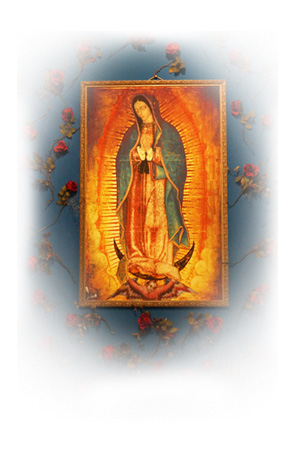
Medjugorje Message: October 25, 2025
Dear children! The Most High in His goodness gave me to you to lead you on the way of peace. Many have responded and are praying, but there are many creatures who do not have peace and have not come to know the God of love. Therefore, little children, pray and love, create prayer groups to encourage each other to the good. I am with you and am praying for your conversion. Thank you for having responded to my call.
River of Light
November 2025
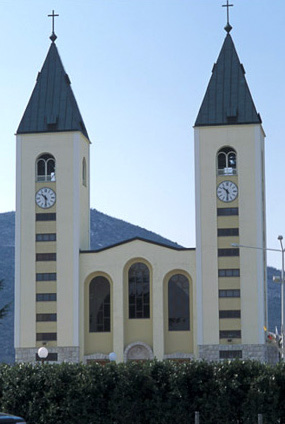 This message from Our Lady is a continuation and further explication of her last message, which was shockingly brief: “May this time for you be a time of prayer for peace.” This month, Our Lady returns to “Square One” or “Ground Zero” by giving us an overview of her 44-year mission as “Queen of Peace” in Medjugorje. She begins by reminding us of how she came to be there in the first place: “The Most High in His goodness gave me to you to lead you on the way of peace.” We have had the great privilege of Our Lady’s presence in Medjugorje these past 44 years—an unprecedented length of time for a Marian apparition, which typically ends within DAYS, not years—yet only through the grace of God, “the Most High” [who] in His goodness gave me to you.”
So, Our Lady did not show up in Medjugorje in June 1981 through some random whim of her own! Rather, it was through a Divine Initiative of God’s “goodness” and generosity. Just as the crucified Jesus from Calvary explicitly gave Mary His Mother to us over 2,000 years ago—again, Our Lady says, the “Most High” gave her to us in Medjugorje. The purpose of her mission? Our Lady says clearly: “to lead you on the way of peace.” How blessed we are by this maternal presence with us in this challenging era of human history!
Next, Our Lady reports the progress and results of her mission thus far: “Many have responded and are praying, but there are many creatures who do not have peace and have not come to know the God of love.” From the earliest days in Medjugorje, Our Lady repeated, “Peace, peace, peace!” and “Pray, pray, pray!” Introducing herself to the young visionaries as the “Queen of Peace” and calling the world to conversion of heart, she made it clear that the path to BOTH peace and conversion is PRAYER.
Every month for over 40 years, she has thanked us “for having responded to my call” —i.e. for PRAYING. For Our Lady, those who PRAY are the ones who “have responded.” And those who PRAY also discover that in time they “HAVE PEACE” because PRAYER connects us with God-Who-Is-LOVE, our Triune Source and Creator. A deepening relationship with God through prayer brings to us a clear confidence in the Divine Indwelling Presence at the core of our being. This becoming “present to the Presence” of Divine Love at our center naturally fills our hearts with PEACE—the “peace that passes understanding” (Phil 4:7), the “peace which the world cannot give.” (Jn 14:27)
Sadly and disappointingly Our Lady reports, “but there are many creatures who do not have peace and have not come to know the God of love.” Why does she use the word “creatures” here? Surely she is referring to men and women—not animals, for it seems that instinctually, through an “organic sensation of Being,” dogs, cats, and all members of the animal kingdom, as well as the rest of Creation, live in the inner “peace” of knowing “the God of love.” HUMANS are the only “creatures” who can lose peace—“the tranquility of order” (St. Thomas Aquinas)—through a deliberate misalignment with Divine Order or cosmic law that the rest of creation obeys “naturally and automatically.” So why doesn’t Our Lady say, “there are many people (or humans) who do not have peace and have not come to know the God of love”?
To call these persons “creatures” who do not have/know/experience “peace” and “the God of love” reminds us of the creation account in Genesis: that HUMAN BEINGS were created “in the divine image and likeness,” and thus destined for “divinization“—to grow more and more “like God” through ever-greater conformity to LOVE. To lack the experience of God-Who-Is-Love—the very Source and template of our essential being—is in fact “dehumanizing.” It renders us “less human” in a way, or perhaps “pre-human.”
To be “fully human” is to be moving, growing, changing, converting daily into a more complete “image and likeness” of our God-Who-Is-Love. Through lack of prayer and a willful refusal to take the Spiritual Journey toward our full humanness—becoming “fully mature with the fullness of Christ” (Eph 4:13)—many today “do not have peace and have not come to know the God of love.” For a human being, this is life’s greatest tragedy, as something fundamental to our very humanity itself is missing.
The devastating effects of this “peacelessness” and functional atheism (“without-God-ness” ) are seen everywhere in our troubled world: brutal territorial wars that rage on and on; rampant gun violence; egomania and “self-will run riot” of extremist authoritarian leaders flouting the rule of law and violating basic human rights; corporate greed and unconscionable bloodlust for exploiting Earth’s natural resources with no care for the irreparable environmental destruction of the gift of Creation; the pandemic of mental illness, anxiety, depression, and suicidal despair in our youth who have lost all future hope; the degrading consumerism and monetizing of our materialistic culture that feeds addictions and hoarding to meet the insatiable needs of the “God-sized” void in our souls; and the hate-filled polarization of a world steeped in 24/7 extremist rhetoric on our digital screens that provide algorithms for nonstop “rage-bait” to fuel division through the “fake news” of propaganda on all sides.
In this tragically DEHUMANIZING state of our current world, indeed “there are many creatures who do not have peace and have not come to know the God of love” —the God who alone can “HUMANIZE” us to live in the divine image and likeness we are meant to reflect. Indeed to be fully “human” is to reflect “the Most High in His goodness” who wants to dwell within every creature.
Our Lady concludes her message with a concrete request: “Therefore, little children, pray and love, create prayer groups to encourage each other to the good. I am with you and am praying for your conversion.” These closing words of Our Lady include “pray, prayer, and praying,” thus returning to her consistent keynote message of Medjugorje—the vital necessity of PRAYER for reaching our goals of conversion and peace. But notice that she clearly links PRAYER to ACTION, telling us to both “PRAY and LOVE,” and to “create prayer groups to encourage each other to the good.” Here Our Lady acknowledges our human need for community in order to cultivate LOVE.
The interpersonal connections of a “group” provide us with a concrete environment in which to practice lovingkindness, care, compassion, service, and mutual “encouragement to the good.” Part of our full HUMANITY is our need for companionship in order to practice both giving and receiving LOVE. This renders us “images” of our God-Who-Is-Love—“creatures” who truly reflect our Creator. As supreme model and example, Our Lady ends by saying, “I am with you and am praying for your conversion” —both walking with us as companion on the Spiritual Journey toward our full humanization/ divinization, AND praying for our conversion from selfish worldly chaos to deep inner peace in Christ.
+ + + + + + +
Empty yourself. Sit quietly, content with the grace of God.
—St. Romuald
The purpose of silence is to break through the crust of the false self.
—Fr. Thomas Keating, OCSO
If God is the center of your life, no words are necessary. Your mere presence will touch hearts.
—St. Vincent de Paul
It is better in prayer to have a heart without words than to have words without a heart.
—Mohandas K. Gandhi
Contemplation is a wordless resting in the presence of God beyond all thoughts and images.
—James Finley
+ + + + + + +
We cannot solve our problems with the same thinking that we used when we created them.
—Albert Einstein
Division begins in the MIND and can be ended by the HEART.
—Robb Smith
+ + + + + + +
Science can purify religion from error and superstition; religion can purify science from idolatry and false absolutes. Each can draw the other into a wider world, a world in which both can flourish.
—St. John Paul II
+ + + + + + +
“Incarnatio continua!”: The Incarnation continues IN you, AS you.
+ + + + + + +
Find inner peace and thousands around you will find salvation.
The purpose of the Christian life is the acquisition of the Holy Spirit.
—St. Seraphim of Sarov
+ + + + + + +
LOVE is the most universal, the most tremendous and the most mystical of cosmic forces. LOVE is the primal and universal psychic energy. LOVE is a sacred reserve of energy; it is the blood of spiritual evolution.
—Fr. Pierre Teilhard de Chardin
+ + + + + + +
Every being exists in intimate relation with other beings and in constant exchange of gifts with each other.
—Fr. Thomas Berry, CP
+ + + + + + +
Recognizing “enoughness” is a radical act in an economy that is always urging us to consume more.
—Robin Wall Kimmerer
+ + + + + + +
Our Amma/Abba, Divine Source-Who-Is-Love,
Whole and Holy is Your Name.
May Your reign of Love come, Your will of Love be done
Here on earth, just as it is with You.
You give us each day all that we need
and You hold no accounts against us,
just as we wish to hold no accounts against each other or ourselves.
Leave us not in temptation of believing the lie of separation,
But deliver us from its consequences of acting out in fear
and the evil delusions of ego.
For Yours is the power and the glory of endless Life, Light, and Love
now and forever, amen.
—Aramaic translation of the Lord’s Prayer
+ + + + + + +
November: Month of All Saints and All Souls
The saint is the most important person in the world because the saint is the decisive answer to the big riddle: What is a human being? The saint is the terrifying statement: humans are sanctifiable, “holy-able.” The human is created and called to be perfected in such holiness and to exist for eternity. Is there a greater, more exciting claim about us? And is not the fact itself enormous, that the Church never runs out of courage and breath to shout this unlikely assertion out loud into the world, from century to century?
Revelation expressly dictates it. The Old Testament already commanded: “Be holy, for I am the Lord your God.” When the New Testament tells us, “You, therefore, must be perfect, as your Heavenly Father is perfect…for this is the will of God, your sanctification,” the meaning has already expanded and deepened. When holiness is claimed by people, it is an expression that this person has been gripped by God, that divine life has broken into us. All human holiness is bestowed holiness, it is a “reflection.” After the coming of Jesus, from now on, humans receive a share in the holy being of God by grace. Thus the early Church addressed ALL her members as saints—sanctified people incorporated into God.
—Ida Friederike Görres
+ + + + + + +
The Church has numbered in the rank of saints not only monks, along with princes and princesses, kings and queens, emperors and empresses, but also merchants, teachers, greengrocers, farmers, shepherds, lawyers and doctors, bankers and clerks, beggars and servants, craftsmen, housewives, shoemakers, carpenters and blacksmiths.
—Henri Joly
+ + + + + + +
The widespread notion that saints were not like us is simply false. They also were subject to temptation, also fell and got up again, felt oppressed by sadness, weakened, and paralyzed by discouragement. However, mindful of the words of the Savior: “Apart from me you can do nothing,” and those of St. Paul: “I have strength for everything in him who strengthens me,” they did not rely on themselves, but, putting all their trust in God, after every fall, they humbled themselves; they sincerely repented, cleansed their soul in the sacrament of penance, and then set down to work with even greater fervor.
—St. Maximilian Kolbe
+ + + + + + +
John Henry Newman (canonized six years ago by Pope Francis) is a saint perfectly suited to clarify our distracted, fearful 21st century minds. He left a treasure trove of prayers on the theme of vocation. Unlike a career or job, a vocation is a calling from God—and we all have one. Within our universal call to love and serve God, each of us has a vocation within a vocation, a unique mission given specifically to us by God to make us happy and to fulfill the grand design that God alone understands.
In 1848, Newman declared, “God has created me to do him some definite service; he has committed some work to me which he has not committed to another. I have my mission—I may never know it in this life, but I shall be told it in the next. Somehow I am necessary for his purposes. I have a part in this great work; I am a link in a chain, a bond of connection between persons. He has not created me for nothing. I shall do good. I shall do his work; I shall be an angel of peace, a preacher of truth in my own place, while not intending it, if I but keep his commandments and serve him in my calling. Therefore I will trust him. Whatever and wherever I am, I cannot be thrown away. Let me be Thy blind instrument. I ask not to see, I ask not to know—I ask simply that You use me.”
—Anne Burleigh
+ + + + + + +
Can American Catholicism help lead the way toward a different political culture—one not rooted in rage, fear and demonization, but in truth, respect, listening, generous disagreement and Gospel nonviolence? The Catholic Church has a long intellectual and social gospel tradition that promotes reasoned and responsible dialogue rather than violence. Political extremism thrives on the opposite premise—that might makes right and intimidation is the quickest path to victory. The Catholic intellectual tradition insists on reasoned discourse, and Catholic social teaching insists on the dignity of every person as the starting point for any political vision. Political violence is a betrayal of both faith and reason.
The Eucharist, which makes the many one body, offers the deepest communal ritual and antidote to polarization. American Catholics who take the Eucharist seriously cannot be comfortable with divisive vitriol, violent rhetoric, much less violent acts. Yet American Catholicism has often been slow to live up to its own vision. At decisive historical moments, when courage was most needed, the Church often faltered. During the anti-slavery movement, the civil rights struggle, the fight for women’s rights, the epidemic of gun violence, and in the face of extreme policies that erode democratic norms, stigmatize immigrants, weaponize religious symbols and normalize violent rhetoric—many Catholic leaders remain ambivalent or even align with political power and privilege, thus remaining complicit in structures of death.
We must call out political violence with moral clarity and without partisan hesitation. And we must take personal responsibility for the way we speak and act. Each careless word that demonizes or reduces others to stereotypes contributes to the potential for violence. Each word of respect, act of restraint, and effort to understand another’s perspective builds a culture of encounter and respect where violence will less likely take root. The path of dialogue, reason and Gospel nonviolence is arduous, but it is the only path that can lead to renewal. As Catholics, we must walk this path ourselves and invite the nation along it.
—Fr. Stan Chu Ilo
+ + + + + + +
Let us learn not to call the rich lucky nor the poor unfortunate. Rather, if we are to tell the truth, the rich person is not the one who has collected many possessions but the one who needs few possessions; and the poor person is not the one who has no possessions but the one who has many desires. We ought to consider this the definition of poverty and wealth. If you see someone greedy for many things, you should consider him the poorest of all, even if he has everyone’s money. If you see someone with few needs, you should count him the richest of all, even if he has acquired nothing. We are to judge poverty and affluence by the disposition of the mind, not by the measure of one’s substance. Whoever has no need of others’ property but is happy and satisfied with what they have is the most affluent of all.
—St. John Chrysostom
+ + + + + + +
“Do you think I have come to establish peace on earth? No, I tell you, but rather division.”
Is peace something Jesus brings or isn’t it? He says both. Peace, yes—but not any kind of peace. Perhaps we need to know the difference between peace lovers and peacemakers. It’s only the latter that Jesus congratulates in the beatitudes: Blessed are the peacemakers. Peace lovers like the way things are, at home, in their community, nations, or their religion. They don’t want anybody to rock the boat by raising inappropriate questions or pointing out things that are unjust or need serious improvement.
Peacemakers are the voice of the voiceless, those who are not afraid to confront. They speak out if there is an issue of serious importance. Peace lovers like everything as it is, for fear of losing the kind of peace that they mistake for the true peace that Jesus brings. Jesus says, “Do you think I have come to establish your idea of peace in this world?” No. On the contrary, I have come to shake up your concept of what happiness and peace is. I have come to shatter the symbols that you think are important to the achievement of your myth (triumphant revenge on your enemies, etc.). This didn’t go down too well for the disciples. It doesn’t go down well for us, because the same question is addressed to us in the present moment.
Our hateful, critical, painful myths that support human degradation are not the peace that Jesus has brought. Rather he brings the kind of question that invites us gently in the here and now to begin to dismantle the myths on which we live. To face our own myths is a great accomplishment. It does not come easily and requires the divine exercise of division that points to the insubstantiality of our myth, the superficiality of our ideas of peace, such as: good reputation, good income, good portfolio, good entertainment, good acceptance by family and friends, good professional success. The kingdom is not worldly success; these are not the values by which we can live as a fundamental base for our life.
The shattering of our myths: “I have come to set the earth on fire, and how I wish it were already blazing,” Jesus says. An unbearable confrontation with the darkness in ourselves: the point where we see what salvation means, as we face in ourselves the anguish, desolation, alienation and self-made hell that we have been projecting onto others. God joins us at this point of utter powerlessness and the pain of losing all the symbols we thought would bring us peace.
Letting go of our undue attachment or dependency upon the methods we thought would bring us happiness—the peace the world offers—we find the peace that is total gift: the peace of God’s infinite mercy.
—Fr. Thomas Keating, OCSO
+ + + + + + +
Life may be brimming over with experiences, but somewhere, deep inside, all of us carry a vast and fruitful loneliness wherever we go. And sometimes the most important thing in the whole day is the rest we take between two deep breaths, or the turning inward in prayer for five short minutes.
—Etty Hillesum
+ + + + + + +
DEVOTION prioritizes one’s life and attracts that which is of assistance. To be a servant of God is a dedication whereby the goal takes precedence over all other positions, attractions, or distractions. By devotion and commitment, the pathway unfolds and revelation supplants cause-and-effect acquisition. Devotion also expresses as selfless service whereby peeling the potatoes is no longer a chore but an act of love because it has been sanctified by intention.
—David Hawkins
+ + + + + + +
Transformation occurs through bodies. Christ was our model: he incarnated fully in the human condition, yet without a sense of separation from his Divine source. So too, we. We are to incarnate fully in our bodies, take our place and fulfill our Divine-human destiny. This flows from the cosmic Whole to our individual part.
The universe is a creation. The creation was a dynamic movement from the cosmic Whole into the cosmic plurality of phenomena, so that intelligent creatures are ultimately the products of higher intelligence, not chance development. The purpose of the universe, and all that is in it, is that the plurality should maintain the cosmic Whole by transforming coarser substances into finer, and thereby have the chance to itself evolve into a higher form.
The highest purpose of humanity is consciously joining in that process of maintaining the Whole through the conscious transformation of received substances, and so developing objective reason, and evolving to serve higher purposes as a higher form of life. The cosmos is a designed and interrelated creation.
—Joseph Azize
+ + + + + + +
We are living in tumultuous times. Political polarization intensifies, violence against vulnerable populations escalates, and the foundational principles of human dignity face erosion. How do we reconcile claims of “In God we trust” with systemic abandonment of the most vulnerable? The question facing Christianity today is not whether to engage the world’s struggles but how to do so in ways that genuinely feed humanity’s capacity for hope, meaning, and transformative action.
Every human activity and dimension of material existence offers potential encounter with the divine. Engaging deeply with the world—scientific research, technological development, social improvement, creative work—is itself communion with God. The divine milieu pervades all things, making every human activity potentially sacred. Scientists, engineers, social workers, artists—all participate in God’s creative work when they act with love and consciousness. Evolution is not merely biological or social but fundamentally spiritual. The entire process aims toward higher consciousness, greater interiority, deeper capacity for love and understanding.
Christian mission means helping humanity recognize evolution’s spiritual dimension. Christians become midwives to the next stage of consciousness, helping humanity recognize that we are not passive observers but active collaborators in the evolution of divine love. Every authentic act of love advances evolution. Every act of justice and gesture toward unity contributes to the fulfillment of cosmic purpose. This is mission for an evolutionary age—to be engaged with matter as the very body of the cosmic Christ.
—Sr. Ilia Delio, OSF
+ + + + + + +
After Francis of Assisi had a life-changing encounter with lepers, he said he “delayed a little and then left the world.” This meant leaving what we call the “system.” He began an alternative lifestyle, called “a life of penance,” or abandoning the system. He decided to focus on alleviating the needs and suffering of others instead of self-advancement. Most of our decisions are based on personal, egoic preference and choice. This is the life that we are called to “leave,” the self that Jesus says must “die” to fall into our True Self. Freedom for both Jesus and Francis was simply freedom from the self, which is freedom for the world. To be free for a full, authentic life, we must be free from our smaller selves.
Half the Gospels are stories of Jesus healing human pain and suffering. He did not focus on sin. Francis did the same. In our Western notions, our first question is “What do I want?” or “What pleases me?” It really doesn’t matter what I want. We are not free at all until we are free from ourselves. It’s that simple and that hard.
—Fr. Richard Rohr, OFM
+ + + + + + +
We are all bound by a covenant of reciprocity: plant breath for animal breath, winter and summer, predator and prey, grass and fire, night and day, living and dying. Water knows this, clouds know this. Soil and rocks know they are dancing in a continuous giveaway of making, unmaking, and making again the earth. Our elders say that ceremony is the way we can remember to remember. In the dance of the giveaway, remember that the earth is a gift that we must pass on, just as it came to us. When we forget, the dances we’ll need will be for mourning. For the passing of polar bears, the silence of cranes, for the death of rivers and the memory of snow.
—Robin Wall Kimmerer
+ + + + + + +
Christ is the center of my life. When I receive the Eucharist, I am receiving the Body of Christ. But I believe that all of humanity is the Body of Christ. Therefore, when I receive the Eucharist, it is not just the union between two persons (myself and Christ), but a union with all of creation, which is the Body of Christ. When I receive the Eucharist, I am receiving in me all of creation, and I need time to be ready for that. (spending several hours in silence)
—Fr. Thomas Keating, OCSO
+ + + + + + +
Wisdom from Pope Leo XIV
In a world where the poor are increasingly numerous, we paradoxically see the growth of a wealthy elite, living in a bubble of comfort and luxury, almost in another world compared to ordinary people. We must not let our guard down when it comes to poverty. There is no shortage of theories attempting to justify this present state of affairs or to explain that economic thinking requires us to wait for invisible market forces to resolve everything. Nevertheless, the dignity of every human person must be respected today, not tomorrow, and the extreme poverty of all those to whom this dignity is denied should constantly weigh upon our consciences.
It is easy to perceive the worldliness behind these positions, which lead us to view reality through superficial lenses, lacking any light from above, and to cultivate relationships that bring us security and a position of privilege. Yet we must never forget that the Christian religion cannot be limited to the private sphere.…Our prosperity can make us blind to the needs of others, and even make us think that our happiness and fulfillment depend on ourselves alone, apart from others. In such cases, the poor can act as silent teachers for us, making us conscious of our presumption and instilling within us a rightful spirit of humility. The poor expose the attitude of aggressive arrogance with which we frequently confront life’s difficulties and remind us how uncertain and empty our seemingly safe and secure lives may be.
—Apostolic Exhortation, “Dilexi Te”
To reject the contemplative dimension of any religion is to reject the religion itself, however loyal one may be to its externals and rituals. This is because the contemplative dimension is the heart and soul of every religion. It initiates the movement into higher states of consciousness. The great wisdom teachings of the Vedas, Upanishads, Buddhist Sutras, Old and New Testaments, and the Koran bear witness to this truth. Right now there are about two billion Christians on the planet. If a significant portion of them were to embrace the contemplative dimension of the gospel, the emerging global society would experience a powerful surge toward enduring peace. If this contemplative dimension of the Christian religion is not presented, the Gospel is not being adequately preached.