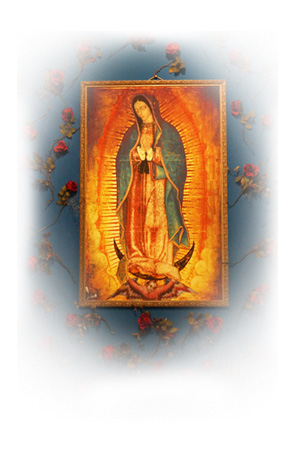
Medjugorje Message: November 25, 2025
Dear children! In this time of grace, I am calling you to follow me. Pray for those who do not pray and do not want peace and joy, which only the Most High can give. May your souls be united in the joy of expectancy and your heart will be filled with peace. You will be convinced, little children, that all will be good and that God will bless all; because the good that you give will return to you, and joy will enfold your heart because you are with God and in God. Thank you for having responded to my call.
River of Light
December 2025
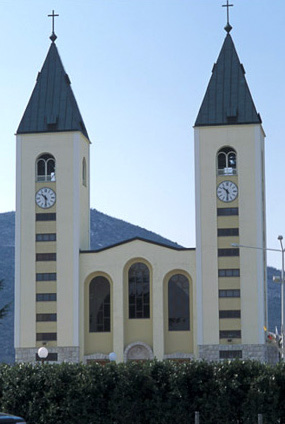 This beautiful Advent message from Medjugorje seems to give us a glimpse into Our Lady’s own inner state during her miraculous pregnancy and the time of awaiting the birth of her Son, Jesus—Prince of Peace, Savior of the world, and King of the Universe. She describes for us what Advent can actually be for US, too, based on her original experience of the first “Advent season” which we contemplate in the Joyful Mysteries of the rosary.
Our Lady begins: “In this time of grace, I am calling you to follow me.” As we enter into the holy season of Advent with its quiet challenge to our noisy, rushing Western mindset of frenzied hyperactivity, who better to “follow” than Mary, Queen of Peace? Who better to “follow” into Advent’s spirit of silent, hope-filled, contemplative waiting—with trusting love and joyful anticipation—than Mary, the Mother of God, who did it first and best?
She continues: “Pray for those who do not pray and do not want peace and joy, which only the Most High can give.” At first glance, we might doubt that there are any people on earth who “do not want peace and joy.” Doesn’t everyone? But Our Lady recalls clearly the “peacelessness” and “joylessness” that her inexplicable pregnancy brought to those who would view her status as an “unwed mother” and the “out-of-wedlock” child in her womb with scorn, derision, ridicule, and even murderous rage that could result in her legal stoning to death. Since that time, how many unborn babies have likewise NOT been welcomed with “peace and joy” by those who “do not want” them as gifts of the “peace and joy which only the Most High can give“? Our Lady knows well the depth of human misery born of our blind or misguided “wanting.”
In reality, as Our Lady says, there is an AUTHENTIC “peace and joy, which only the Most High can give.” This spiritual “peace and joy” is centered in the Divine Indwelling Presence of Love in every heart that has opened to God in prayer. “Those who do not pray” —i.e. don’t have a living relationship with their Source-Who-Is-Love—also want “peace and joy,” of course; but sadly, they seek a counterfeit and phony “peace and joy” that the WORLD offers to fill the void of our human condition’s emotional “holes.” These “fillers” are the culture’s symbols for safety/ security, affection/ esteem, and power/ control—manmade programs that promise everyone “peace and joy,” but only “as the world gives”: a fragile, fleeting, superficial, self-centered, incomplete, and finally failing “peace and joy.”
It is this “worldly” version of peace and joy that today drives millions of people in our 21st century to blindly seek and support things that are totally contrary, opposed, and antithetical to “the peace and joy which only the Most High can give“—things such as abortion, euthanasia, capital punishment, war, inhumane treatment of immigrants, damaging exploitation of nature and God’s creation, corporate greed and disregard for the starving, impoverished, and marginalized of the earth, and the obscene overconsumption of unbridled materialism. These false notions of “peace and joy” which the world pursues have nothing to do with the Prince of Peace of our Advent hope.
Our Lady continues: “May your souls be united in the joy of expectancy and your heart will be filled with peace.” Here we may recall the Second Joyful Mystery of the rosary: Mary’s visit to Elizabeth, her cousin, immediately after the Annunciation by Gabriel which revealed that both women were pregnant. Mary instinctively “went with haste” to the aid and companionship of her elderly cousin, so that the two women could experience their “souls being united in the joy of expectancy.” Upon Mary’s arrival, the unborn John the Baptist “leaped in the womb” of Elizabeth—another “soul united in joy” for the coming Christ-child.
Similarly, during the Advent season we gather in community with “souls united” for joyful celebrations: beautiful liturgies devoted to the Immaculate Conception and Our Lady of Guadalupe, the four candle-clad Sundays of Advent, the parish “posadas” with tamales and hot chocolate, and many secular Christmas parties with family, friends and coworkers that include tree-trimming, treat-baking, decorating, and gift exchanges or “white elephant” swaps—all in the spirit of being “souls united in the joy of expectancy“ leading up to December 25th, the Nativity of Jesus Christ, the Gift whose birth split human history into “B.C.” and “A.D.” (“B.C.E.” and “C.E.”).
As a penitential season, Advent also beckons us to widen our circle of care and compassion by performing works of mercy and attentive service to all who are ill, lonely, poor, elderly, disabled, marginalized, or struggling in any way. And even if we are suffering ourselves, we find that there is always someone who’s worse off, in need of our loving kindness, as Spirit invites us to transcend “self.” So we do these works in the “Christmas Spirit” —again, “united in the joy of expectancy,” as Our Lady says. And indeed, we discover through such communal Advent sharing in both celebration and service to others, Our Lady’s promise fulfilled: “Your heart will be filled with peace.”
But how can we describe this “peace that surpasses understanding” —a peace so different, clearly “not as the world gives“? Our Lady Queen of Peace provides a detailed description as she concludes her message: “You will be convinced, little children, that all will be good and that God will bless all; because the good that you give will return to you, and joy will enfold your heart because you are with God and in God.” Can we imagine what tremendous PEACE we would feel if all our many anxieties about every facet of life gave way to a CONVICTION—being “convinced” beyond doubt—that “ALL WILL BE GOOD and GOD WILL BLESS ALL”? As the mystic Julian of Norwich famously said, “All shall be well, and all shall be well, and all manner of thing shall be well.” Do we believe this? Will living the Advent spirit help us to “be convinced“?
As the four weeks of Advent proceed and culminate in the “Silent Night” of Midnight Mass and the “Joy to the World” of Christmas morning, we find our hearts “filled with peace” through the spirit of giving and receiving we’ve experienced. The Incarnation of Love in Bethlehem is made real here and now. It touches us personally through the care other people show us, making us realize we are “with God,” and through the care we have shown to others, making us realize we are “in God” who acts as LOVE Incarnate through us. Scripture tells us, “GOD IS LOVE, and whoever remains in love remains in God, and God in that person.” (1 Jn 4:16) Jesus says, “Remain in me, and I will remain in you.” (Jn 15:4)
The real beauty of Our Lady’s Advent message is its multi-layered truth, for everything that she says about these four weeks of the Advent season leading up to Christmas day—our Lord’s “First Coming” —can be equally said of the days, weeks, months, and years of our whole human lifetime leading up to the Day of our Lord’s Return, or “Second Coming“ to us. For our entire life is truly an “Advent season” —a “time of grace” and preparation when we are called to “follow” Mary’s example and “pray for those who do not pray,” to experience the “peace and joy which only the Most High can give.”
Throughout our whole lifetime we’re called to give witness to being “united in the joy of expectancy.” Expecting what? The moment when Jesus will come to liberate us and take us home, victorious, with him! As we progress on the spiritual journey through life, with living faith, we will increasingly “be convinced that all will be good and that God will bless all,” and that “the good that we give” throughout our whole life of faith “will return to us“: as Scripture says, “pressed down, shaken together, and overflowing” (Lk 6:38) —reaping even more than we sow, by God’s grace.
This blessing can be ours any day or time when we are awake, aware, and consciously united to God through PRAYER, with an open, receptive heart abiding in the Divine Presence. As we become increasingly “present to Presence” and the kingdom of God “among” and “within” us, we will find, as St. Catherine of Siena said, that “All the way to heaven is heaven!” And after death, in heaven, to an unimaginable degree, “joy will enfold our heart because we are with God and in God.”
Advent is thus a DOUBLY-BLESSED season of waiting in anticipation—both for the joy of Jesus’ coming on Christmas Day AND for the joy of Christ’s return on our personal “Liberation Day“…which can be any time! Quiet reflection and silent prayer, along with heartfelt works of charity, are the best preparation for both Advents of the Lord.
+ + + + + + +
Empty yourself. Sit quietly, content with the grace of God.
—St. Romuald
The purpose of silence is to break through the crust of the false self.
—Fr. Thomas Keating, OCSO
If God is the center of your life, no words are necessary. Your mere presence will touch hearts.
—St. Vincent de Paul
It is better in prayer to have a heart without words than to have words without a heart.
—Mohandas K. Gandhi
Contemplation is a wordless resting in the presence of God beyond all thoughts and images.
—James Finley
+ + + + + + +
We cannot solve our problems with the same thinking that we used when we created them.
—Albert Einstein
Division begins in the MIND and can be ended by the HEART.
—Robb Smith
+ + + + + + +
Science can purify religion from error and superstition; religion can purify science from idolatry and false absolutes. Each can draw the other into a wider world, a world in which both can flourish.
—St. John Paul II
+ + + + + + +
“Incarnatio continua!”: The Incarnation continues IN you, AS you.
+ + + + + + +
Find inner peace and thousands around you will find salvation.
The purpose of the Christian life is the acquisition of the Holy Spirit.
—St. Seraphim of Sarov
+ + + + + + +
LOVE is the most universal, the most tremendous and the most mystical of cosmic forces. LOVE is the primal and universal psychic energy. LOVE is a sacred reserve of energy; it is the blood of spiritual evolution.
—Fr. Pierre Teilhard de Chardin
+ + + + + + +
Every being exists in intimate relation with other beings and in constant exchange of gifts with each other.
—Fr. Thomas Berry, CP
+ + + + + + +
Recognizing “enoughness” is a radical act in an economy that is always urging us to consume more.
—Robin Wall Kimmerer
+ + + + + + +
Our Amma/Abba, Divine Source-Who-Is-Love,
Whole and Holy is Your Name.
May Your reign of Love come, Your will of Love be done
Here on earth, just as it is with You.
You give us each day all that we need
and You hold no accounts against us,
just as we wish to hold no accounts against each other or ourselves.
Leave us not in temptation of believing the lie of separation,
But deliver us from its consequences of acting out in fear
and the evil delusions of ego.
For Yours is the power and the glory of endless Life, Light, and Love
now and forever, amen.
—Aramaic translation of the Lord’s Prayer
+ + + + + + +
In the beginning was the Word,
And the Word was with God,
And the Word was God.
He was in the beginning with God,
All things came to be through Him,
And without Him nothing came to be.
What came to be through Him was life,
And this life was the light of the human race.
The light shines in the darkness,
And the darkness has not overcome it.
—John 1:1-5
There is something wondrous and expectant about the very word “Advent.“ The weather is cold; winter is in the air. The days are growing shorter, the darkness longer. The trees stand stark and bare. All living things have dug their roots into the earth for protection. The forest animals hibernate. People move inside out of the cold.
Just as nature moves deep inside, so too are we invited to turn inward during this time of preparation for the Lord’s coming. This inner preparation, nourished by prayer, silence, scripture and the sacred music and rituals of the season, is essential if we are to celebrate in a worthy manner the holy commemoration of our Lord’s birth.
—Fr. Thomas Keating, OCSO
+ + + + + + +
Advent is a short season, yet it covers a long distance. It is the road of a soul from Nazareth to Bethlehem. It seems such a short distance. Yet it is a road into infinity, into eternity. It has a beginning, but no end. In truth, Advent is the road of the spiritual life which all of us must start if we do not want to miss the way. We must start with a fiat that re-echoes Mary’s fiat—Let it be done, O Lord. It is a fiat that each of us should say in the quiet of our hearts.
Let us arise, then. Let us shake the sleep out of our eyes—the sleep of emotions run amuck; the sleep of indifference, of tepidity, of self-pity, of fighting God. Let us arise from that sleep, and begin our journey to Bethlehem. But let us understand that this “Bethlehem” we seek is within our own souls, our own hearts. It is an inner pilgrimage, a pilgrimage in which we don’t use our feet. Let us enter into the pilgrimage that doesn’t take us from home. For ours is a journey of the spirit, which is a thousand times harder than a journey of the feet. Let us “arise and go.”
—Servant of God Catherine de Hueck Doherty
+ + + + + + +
Let us prepare for Christ in our hearts a dwelling full of patient merits. Let us prepare a crib, a cradle brilliant with the flowers of a good life. Let us receive the tiny little Lord in our hearts; may he grow and make progress there, nourished by faith. May he ascend to youth there, and may he exercise the powers which are mentioned in the Gospel. Within us the Lord has a blind man to whom he can give light, a lame man whose step he can restore. What he did in those who were dead he does in the living. He raises a person to life in the room of his heart.
—St. Caesarius of Arles
+ + + + + + +
This is the invitation of the season of Advent: Incarnatio continua—may the Incarnation continue in us, as us.
If this seems a daunting invitation, recall that our flowering into divine-human beingness is actually akin to relaxing into Is-ness, of receptivity to the Spirit, of allowing and accepting the flow of life. The ego plans and strives and evaluates; Is-ness is, and keeps Is-ing anew in each moment. God is a verb. God is always happening, and that happening is the content of the present moment—whatever that is. On our part, it means a willingness to live in the present moment without being attached to its content and without giving way to an aversion for it. This is learning the divine way to be human, called deification.
Come, let us walk in the light of the Beloved. —Isaiah 2:5
—Fr. Thomas Keating, OCSO
+ + + + + + +
December 8: The Immaculate Conception of the B.V.M.
God chose Mary, the Immaculate Conception, to be our “model of holiness” and the perfect Mother for the Savior. At Mary’s conception, the Lord was already preparing the world for the Incarnation of Jesus within her womb. Mary’s purity makes her closer to us than anyone else, for sin is what divides, while grace unites and heals. Mary loves us with perfect, maternal selflessness. The Immaculate Conception overcomes the trickery of the serpent, begins God’s recreating work of salvation, and renders Mary, in a new way, EVE—“the mother of all the living.“
—Magnificat
Our Lady said her great fiat—the greatest word that could be spoken to the greatest event in our history. But it was only the first time of many. She said fiat all of her life, not just at the Annunciation. It was not just a matter of words; it was a lived avowal. This is what Our Lady shows us. She tells us not just how to say fiat, but how to live it—not only in the large, dramatic occasions of life, but in the little hidden ones. She had many hidden fiats to say in her life.
She was a very active doer in “letting it be done.” Fiat is a very active word. In our human fiat, we have to be active doers in letting it be done. God said “let it be” and the world, the light, and each one of us came into being. It was a word that galvanized into action. Our fiat must be the action of our whole life, expressed in our giving.
—Mother Mary Frances of Our Lady, P.C.C.
+ + + + + + +
Always go to Jesus through Mary, but not for fear of Jesus. Often in books of piety, Jesus is presented as a judge and Mary as the merciful Mother. Yet it is not like that at all, because if Mary has a merciful heart of tenderness, it is Jesus who gave it to her. In the same way that he himself came through Mary, he wants us to go to him through Mary. It is the surest way, the most direct way….No, it is not in fear of God that we go to Mary, but in love for God, and at the same time in love for her, in order to share everything with them. It is Mary’s heart that will reveal to you the intimate secrets of the heart of Jesus, and it is the heart of Jesus which will reveal to you the heart of Mary.
—Fr. Jean du Coeur de Jesus d’Elbée
+ + + + + + +
We’re a nation hungry for more joy…because we’re starving from a lack of gratitude.
—Brené Brown
+ + + + + + +
Misguided images of the Divine as a supernatural trick-performer or powerful tyrant remain with us today, creating stumbling blocks. Many reject such childish notions of God. But through his divine humanity, Jesus reveals an entirely different reality: an expansive realm of Love so unwavering that it will embrace whatever circumstances it meets to pour itself into our world as mercy and compassion. This is an already-present Love—not only a heavenly future, but available now, today, among us and amidst the sufferings of our ordinary lives.
Centering Prayer and other contemplative methods offer ways to daily practice dying to the ego-identified self—to the mistaken notion that we are independent and separate from God or that worldly power, security and acclaim can bring lasting happiness. In this self-surrendering journey, we ask to be reunited with Christ, to live from a consciousness of Divine Love present through all seasons.
—Contemplative Outreach
+ + + + + + +
Monks realize that when the consciousness of one person is raised, the whole of humanity is raised; when the quality of one life improves, all improve. To put it in a more biblical way, the increased health and vitality of any one cell vitalizes the whole Body of Christ.
—Fr. M. Basil Pennington, OCSO
+ + + + + + +
Imagine a country whose citizens—maybe even its leaders—are brave, calm, and open towards each other; a country whose people realize that all human beings belong together as one family and must act accordingly.
—Br. David Steindl-Rast
+ + + + + + +
We were born to make manifest the glory of God that is within us. It is not just in some of us; it is in everyone. And as we let our own light shine, we unconsciously give others permission to do the same. And as we are liberated from our fear, our presence automatically liberates others.
—M. Williamson
+ + + + + + +
How can a divided world be healed? Love is the fundamental structure of reality: the principal energy of evolution, the presence of God in all things. To answer our divisions, we must grow in consciousness and capacity for genuine, planetary love. This is not romantic sentimentalism. It is clear-eyed realism: reality itself is structured by love, and the only solutions to our crises that work are those aligned with love. Political systems that attempt to preserve power through division and fear work against the actual trajectory of evolution and inevitably fail or produce great suffering. Spiritualities that deny the sacredness of the material world or withdraw from engagement with others reject the actual way God is present in reality.
Every single person whether rich, poor, black, trans, straight, Asian, indigenous, homeless, disabled—every person seeks to love and to be loved. “Love alone can bring us to another universe,” Teilhard said. We need a new evolutionary political order of love.
—Sr. Ilia Delio, OSF
+ + + + + + +
To be grateful for the good things that happen in our lives is easy, but to be grateful for all our lives—that requires hard spiritual work. Still, we are only truly grateful people when we can say thank you to all that has brought us to the present moment.
—Fr. Henri Nouwen
+ + + + + + +
God sees absolutely everything and God’s compassion is without limit. There’s nothing to be afraid of. The safest thing in the universe is to fall into the hands of the living God. God, who’s provided the universe, provides what we need in every moment of time. And so the essence of practice is this walking in the presence of God, which is also doing nothing. So whether we are active or passive, we’re always in the Presence. We know that it’s inescapable and we’re willing more and more to let go of our preoccupations and to let God be God in us.
—Fr. Thomas Keating, OCSO
+ + + + + + +
Only light can dissipate darkness. Those of us who carry the light are called to shine the light, to share it so that the world will not sink into total darkness.
—Thich Nhat Hanh
+ + + + + + +
Wisdom from Pope Leo XIV
We are all invited to overcome the scandal of the divisions that unfortunately still exist and to nurture the desire for unity for which the Lord Jesus prayed and gave his life. The more we are reconciled, the more we Christians can bear credible witness to the Gospel of Jesus Christ, which is a proclamation of hope for all. Moreover, it is a message of peace and universal fraternity that transcends the boundaries of our communities and nations.
To reject the contemplative dimension of any religion is to reject the religion itself, however loyal one may be to its externals and rituals. This is because the contemplative dimension is the heart and soul of every religion. It initiates the movement into higher states of consciousness. The great wisdom teachings of the Vedas, Upanishads, Buddhist Sutras, Old and New Testaments, and the Koran bear witness to this truth. Right now there are about two billion Christians on the planet. If a significant portion of them were to embrace the contemplative dimension of the gospel, the emerging global society would experience a powerful surge toward enduring peace. If this contemplative dimension of the Christian religion is not presented, the Gospel is not being adequately preached.
—Fr. Thomas Keating, OCSO