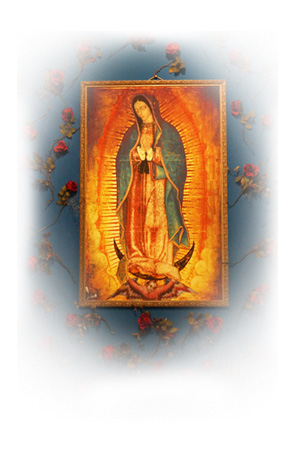
Medjugorje Message: June 25, 2025
Dear children! Also today I thank the Almighty that I am with you and that I can lead you towards the God of love and peace. The ideologies which destroy you and your spiritual life are transitory. I am calling you, little children: return to God, because with God you have a future and eternal life. Thank you for having responded to my call.
River of Light
July 2025
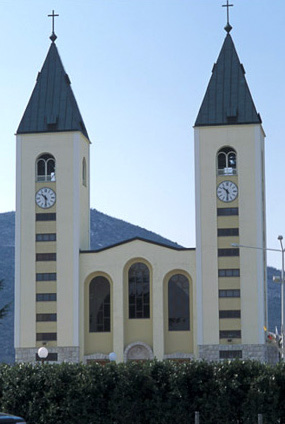 On this 44th Anniversary of Mary, Queen of Peace in Medjugorje, Our Lady’s message minces no words but speaks plainly to the present reality of our world. She begins: “Also today I thank the Almighty that I am with you and that I can lead you towards the God of love and peace.” Amazingly, it has now been 44 years since Our Lady’s first apparition and message at Medjugorje—June 25, 1981—when she said, “Peace, peace, peace! Only peace!” and identified herself to the six young visionaries as the “Queen of Peace.” Here we are, 44 years of DAILY Marian apparitions later—historically an unprecedented duration and unbelievable outpouring of divine grace—and STILL we are a planet and a human species desperately in need of being “led towards the God of love and peace.”
Our violent, hateful, war-torn and divided world has seemingly lost its way, adrift upon a vast, chaotic sea of darkness, without compass or rudder with which to navigate and steer our ship toward the light of Spirit. In place of spiritual maturity, we are still like infants hungering and thirsting for our Mother’s life-giving nourishment, the vital food of God’s “love and peace” which alone can build up an inner spirit that thrives. How has our 21st century world “blown so far off-course” and “sunk so low”?
Our Lady tells us bluntly: “The ideologies which destroy you and your spiritual life are transitory.” Understanding this statement is the key to unlocking Our Lady’s message. She has been sent by “the Almighty” to “lead us towards the God of love and peace“—towards the Ultimate Good, the Eternal Reality that brings us to life everlasting: the SPIRITUAL or TRUE LIFE of which this world is only a shadow and pale reflection. In stark contrast, as the opposing counterpoint to this eternal and everlasting “God of love and peace,” Our Lady shines a spotlight upon a great enemy of our soul; she exposes and calls out “the ideologies which destroy you and your spiritual life.” What does Our Lady mean by this severe and scathing indictment? What are “ideologies,” and how do they “destroy us and our spiritual life“?
An “ideology” is a human-made belief system that informs a person’s ideas, attitudes, and worldview—a philosophical framework for understanding the world and guiding “how things should be done” in society or government. Most often, ideologies revolve around a political, social, economic, or religious viewpoint. Simply put, “ideologies” are “ism’s” such as: nationalism, capitalism, communism, socialism, fascism, nazism, Marxism, anarchism, populism, authoritarianism, totalitarianism, conservatism, liberalism, colonialism, stoicism, expansionism, isolationism, collectivism, militarism, sexism, racism, classism, feminism, chauvinism, fundamentalism, terrorism, materialism, consumerism, hedonism, paganism, relativism, rationalism, monotheism, polytheism, catholicism, protestantism, humanism. And in today’s American jargon, we’ve added “Trumpism” and “woke-ism“!
If we look at our tragically divided modern world, we find strife and peacelessness on every level, starting with the family, then the neighborhood or civic community, then the state, then the nation, then the international global arena, with nuclear threats and many countries at war (Middle East, Europe, Africa, etc.). Looking closely, we can see that IDEOLOGIES play the part of a dividing force at every level of peacelessness in our world.
In our own USA, over the past decades the “Great Divide” that has split our nation is political ideology: “Red” vs. “Blue”…”Left” vs. “Right”—and this division has bled into every level of human relationship, from the American family whose members are so irrevocably at odds that they can no longer speak to each other, to the recent politically-motivated assassinations of lawmakers. Common courtesy and civility of speech in public discourse have given way to crude adolescent profanity, cursing, and name-calling, even at the highest echelons of government leadership. Respect for the universal dignity of the human person seems to be the first and worst casualty of “ideologies.”
A simple “theory” or “philosophy” becomes an “ideology” when its followers or proponents become increasingly zealous and convinced that “this way” is the ONLY right way to think about life or some aspect of life. Extremism ramps up as a GROUP forms around the ideology, so that there are now “in-group” and “out-group” members—whereupon “us” vs. “them” thinking begins to take root: those in the “out” group who do not hold the ideology are now seen as “enemies” who must be opposed for the sake of the ideology’s “one right way.”
Thus ideologies become a major feature of “Mythic-Membership” consciousness. At this level of human consciousness, people get their sense of IDENTITY from the GROUP(s) to which they belong—family, gender, race, class, nation, political party, religion, sexual orientation, etc. With this mentality, my entire identity depends upon and is reduced to my “belonging” to a particular group, and “membership” in the group defines who I am.
This lower “mythic membership” level of human development can sometimes be centered on a charismatic leader and become a cult, leading to such tragedies as the Jim Jones and David Koresh group suicides, the ISIS terrorist/suicide bomber killings, and Hitler’s Third Reich and the Nazi holocaust of six million Jews. Ideologies produce “ideologues“ who are extreme, uncompromising, dogmatic, obsessive, brainwashed, and blinded by a myopic single-sightedness that admits only the one-dimensional “truth” of the ideology. “My way or the highway” is the ideological stance; thus “-ism’s” lead to schisms! Our Lady says they “destroy you and your spiritual life,” for they incite judgmental disdain, disrespect, and hatred toward the “other”—becoming a callous disregard for the innate dignity of EVERY human person.
St. John Paul II often spoke of the danger of ideologies. In his encyclical, Centissimus Annus, he bemoaned the “past ideologies of hatred” and the “new ideologies which exalt violence, appearing on the horizon.” He saw that the arms race and war were always supported by “an ideology—a perversion of authentic philosophy, called upon to provide doctrinal justification for the new war.” He said, “In situations strongly influenced by ideology, in which polarization obscures the awareness of the human dignity common to all, the Church affirms clearly and forcefully that every individual—whatever his or her personal convictions—bears the image of God and therefore deserves respect.”
Indeed, the destructive power of ideologies that Our Lady mentions lies in their blind adherence to their own partial and transitory guiding principles as the “ONLY TRUTH” for everyone, once and for all, forever. Jesus condemned the ideologues of his own religion, the Pharisees, calling them “blind guides,” “whitewashed tombs,” “vipers,” and “hypocrites” who were “teaching as doctrines the precepts of men.” Elevating human-made rules to the level of transcendent spiritual truth with divine authority is the great downfall of Pharisaism and of every other ideological “-ism” to which humans pledge their allegiance.
Our Lady points out that—in contrast to her leading us “towards the God of love and peace” who is “the same, yesterday, today, and forever” (Heb 13:8)—“the ideologies which destroy you and your spiritual life are TRANSITORY.” This is their great weakness: they are “time-sensitive” and “history-bound” viewpoints based upon the changing conditions and circumstances of this fickle and ever-morphing world. Our “mythic membership” in an ideology (whether Trumpism or woke-ism) is a “house built on sand,” while following “the God of love and peace” is the “house built on rock“ of the Lord’s gospel parable. (Mt 7, Lk 6) Our various ideologies of the “perfect world” that we would impose upon everyone are only passing, short-lived “Towers of Babel” in contrast to the timeless and enduring “God of love and peace“ to whom all of our attention should be directed throughout this life.
St. John Paul II wrote: “When people think they possess the secret of a perfect social organization which makes evil impossible, they also think that they can use any means, including violence and deceit, in order to bring it into being. Politics then becomes a secular religion which operates under the illusion of creating paradise in this world. But no political society which possesses its own autonomy and laws can ever be confused with the Kingdom of God….Man cannot give himself to a purely human plan for reality, to an abstract ideal or a false utopia. As a person, he can give himself to other persons and ultimately to God. A man is alienated if he refuses to transcend himself and to live the experience of self-giving…oriented towards his final destiny which is God.”
Thus, Our Lady says, “I am calling you, little children: return to God, because with God you have a future and eternal life.” Ever reminding us of the “Big Picture” of our life here, “earth-side,” as only a brief blink of the eye, while its vast expanse lies before us on the other side of death, in Heaven—if we continue to choose conversion and “the God of love and peace” over the distractions and ideologies of this world. Our Lady’s message this month speaks to the sad reality of our day: wars, nuclear threats, environmental sickness, and the pervasive peacelessness that results from human ideologies usurping our focus on divine “love and peace.”
St. John Paul II mirrors Our Lady’s concerns and articulates the Church’s wisdom: “Nor does the Church close her eyes to the danger of fanaticism or fundamentalism among those who, in the name of an ideology…claim the right to impose on others their own concept of what is true and good. Christian truth is not of this kind. Since it is not an ideology, the Christian faith does not presume to imprison changing sociopolitical realities in a rigid schema, and it recognizes that human life is realized in history in conditions that are diverse and imperfect. Furthermore, in constantly reaffirming the transcendent dignity of the person, the Church’s method is always that of respect for freedom…. The Christian upholds freedom and serves it, constantly offering to others the truth which he has known.”
Let us be honest: can we see ourselves as “mythic members” of an “ideology” found somewhere in that long list of “-ism’s”? Every day, urgent invitations to “place membership” bombard us from our cable TV “news” channels, talk radio, and electronic devices, spewing endless ideological messages from both the “far right” and “far left,” each with conspiracy theories galore, designed to sow extreme hatred toward “the other.”
If we have “taken the bait” and signed on to any ideologies, let us “return to God” as Our Lady asks, and henceforth focus all our attention and daily efforts—in everything we think, say, and do—upon the one lasting truth we know: “the God of love and peace” to whom Our Lady has been leading us these past 44 years in Medjugorje. Let us join her, as we too, “THANK THE ALMIGHTY” that we have been called to be peacemakers!
+ + + + + + +
Empty yourself. Sit quietly, content with the grace of God.
—St. Romuald
The purpose of silence is to break through the crust of the false self.
—Fr. Thomas Keating, OCSO
If God is the center of your life, no words are necessary. Your mere presence will touch hearts.
—St. Vincent de Paul
It is better in prayer to have a heart without words than to have words without a heart.
—Mohandas K. Gandhi
Contemplation is a wordless resting in the presence of God beyond all thoughts and images.
—James Finley
+ + + + + + +
We cannot solve our problems with the same thinking that we used when we created them.
—Albert Einstein
Division begins in the MIND and can be ended by the HEART.
—Robb Smith
+ + + + + + +
Science can purify religion from error and superstition; religion can purify science from idolatry and false absolutes. Each can draw the other into a wider world, a world in which both can flourish.
—St. John Paul II
+ + + + + + +
“Incarnatio continua!”: The Incarnation continues IN you, AS you.
+ + + + + + +
Find inner peace and thousands around you will find salvation.
The purpose of the Christian life is the acquisition of the Holy Spirit.
—St. Seraphim of Sarov
+ + + + + + +
LOVE is the most universal, the most tremendous and the most mystical of cosmic forces. LOVE is the primal and universal psychic energy. LOVE is a sacred reserve of energy; it is the blood of spiritual evolution.
—Fr. Pierre Teilhard de Chardin
+ + + + + + +
Every being exists in intimate relation with other beings and in constant exchange of gifts with each other.
—Fr. Thomas Berry, CP
+ + + + + + +
Recognizing “enoughness” is a radical act in an economy that is always urging us to consume more.
—Robin Wall Kimmerer
+ + + + + + +
Our Amma/Abba, Divine Source-Who-Is-Love,
Whole and Holy is Your Name.
May Your reign of Love come, Your will of Love be done
Here on earth, just as it is with You.
You give us each day all that we need
and You hold no accounts against us,
just as we wish to hold no accounts against each other or ourselves.
Leave us not in temptation of believing the lie of separation,
But deliver us from its consequences of acting out in fear
and the evil delusions of ego.
For Yours is the power and the glory of endless Life, Light, and Love
now and forever, amen.
—Aramaic translation of the Lord’s Prayer
+ + + + + + +
The foundation of Jesus’ social program is “non-idolatry,” or the withdrawing of our enthrallment from all kingdoms except the kingdom of God. This supports a much better agenda than feeling the need to attack things directly. Nonattachment (freedom from loyalties to human-made domination systems) is the best way of protecting people from religious zealotry or any kind of antagonistic thinking or behavior. While there are certainly things we are against, we must keep concentrating on the big thing we are for!
Paul tries to create some “audiovisual aids” for this big message—“churches.” He knew we need living models of this new kind of life to make evident that Christ’s people really follow a way different from mass consciousness. He needed to be able to say, “Look at these people. They’re different. This is a new social order.”
For Paul, we were supposed to live inside of an alternative society, and from such fullness “go out to the world.” Instead, we created a model where people live mostly in the world, fully invested in the attitudes toward money, war, power—and sometimes “go to church.” Most of us end up thinking and operating like our surrounding culture.
Behavior has a very different emphasis than mere membership.
—Fr. Richard Rohr, OFM
+ + + + + + +
The kingdom of heaven is really a metaphor for a state of consciousness. It is not a place you go to, but a place you come from. It is a whole new way of looking at the world, a transformed awareness that literally turns the world into a different place. It is Jesus’ own favorite way of describing a state we would nowadays call a “nondual consciousness” or “unitive consciousness.” The hallmark of this awareness is no separation—not between God and humans, not between humans and other humans.
When Jesus talks about this Oneness, it is a complete mutual indwelling: I am in God, God is in you, you are in God, we are in each other. His most beautiful symbol for this is the vine and the branches. “Abide in me as I in you.” There is no separation between humans and God because of this mutual interabiding which expresses the indivisible reality of divine love.
We flow into God—and God into us—because it is the nature of love to flow. And as we give ourselves into one another, the vine gives life to the branch while the branch makes visible what the vine is. The whole and the part live together in mutual, loving reciprocity, each belonging to the other and dependent on the other to reveal the fullness of love.
—Rev. Cynthia Bourgeault
+ + + + + + +
It is in this oneing that the life of all people consists. The love of God creates in us such a oneing that when it is truly seen, no person can separate themselves from another.
—Julian of Norwich
+ + + + + + +
Our contemplative practices are in service to this experience of oneing. Our way of seeing reality changes. A restructuring of consciousness takes place which empowers one to perceive and respond to everyday life with increasing sensitivity to the Divine presence in, through, and beyond everything that happens.
—Fr. Thomas Keating, OCSO
+ + + + + + +
“Whoever is in Christ is a new creation.” —2 Cor 5:17
Beatrice Bruteau taught that the Christ is all of us, the totus Christus, as St. Augustine wrote. To live “in” Christ is to “experience oneself as a center of free energy,” to “let an old modality of consciousness die,” to “accept the offer of Jesus and undergo a mutation of consciousness.”
To be “in Christ” is to experience oneself as an initiative of free energy radiating out to give life abundantly to all, for that is the function of the Christ. To be “in Christ” is to be an indispensable member of a living body, which is the Body of Christ.
Christ is the whole, and the whole is the Church. As we enter by our transcendent freedom into Christ, as the ego is reconciled with the deeper levels of the psyche, as the mind integrates its activities through the consolidation of consciousness, one becomes a new creation.
On this level of Christic life, we enter by faith into the future of every person, and into the very heart of creativity itself, into the future of God.
To enter into the Christ self, the self of communal consciousness by which the new creation unfolds with new potential, is a radical break with the way we are “self-conscious,” or constricted egos. We are called to unlearn the habitual consciousness of self-preservation and learn a new way of consciousness, rather than being self-conscious.
—Sr. Ilia Delio, OSF
+ + + + + + +
“Finding our heart” and recovering awareness of our inmost identity implies the recognition that our external, everyday self is to a great extent a mask and a fabrication. It is not our true self. And, indeed, our true self is not easy to find. It is hidden in obscurity and “nothingness” at the center where we are in direct dependence on God.
—Thomas Merton
+ + + + + + +
As we sit in centering prayer, things do become clearer. It is not so much that we have brilliant insights; indeed, during the time of prayer we let all these things go. But there grows in us a deep sense that life does make sense. There is a certain unfolding. What has been hidden from us, the missing pieces of the puzzle of life, seem to show up. It is leavened all through. Something of the completeness, the allness, the peace of heaven begins to be present. God is at the center of our being.
We let God truly be the Lord and master of our domain. The kingdom of God is established within. Ultimately, God is in charge and has everything under control. I accept—no, more: I freely embrace what is because of God’s free choice.
—Fr. Basil Pennington, OCSO
+ + + + + + +
The Eucharist is not a private act of devotion. The Eucharist is a call to and a grace for SERVICE. The Eucharist is meant to send us out into the world ready to give expression to Christ’s hospitality, humility, and self-emptying. The Eucharist is a call to move from worship to service, to take the nourishment, the embrace, the kiss we have just received from God and the community and translate it immediately into loving service of others. To take the Eucharist seriously is to begin to wash the feet of others, especially the feet of the poor.
—Fr. Ron Rolheiser, OMI
+ + + + + + +
There are some who are dependent upon the mood of others for their happiness. There are some whose joy is dependent upon circumstances. There are some who must win their joy against high odds, squeeze it out of the arid ground. There are still others who find their joy deep in the heart of their religious experience. It is not related to, dependent upon, or derived from any circumstances or conditions in which they must live. It is a joy independent of all vicissitudes.
There is a strange quality of awe in their joy, a reflection of the deep calm water of the spirit out of which it comes. It is a discovery of the soul, when God makes known God’s presence, where there are no words, only the Divine Movement. This is the joy that the world cannot give.
—Howard Thurman
+ + + + + + +
The joy that Jesus offers is a joy that exists in very difficult situations. In the spiritual life, joy is something that remains with us…even when we are in touch with very painful things in our lives. If there is anything the church wants to teach us, it is that the joy of God can be with us always—in moments of sickness, health, success, failure, birth, death. This is what the life with God is about. It is being in touch with that love that becomes joy in us. Underneath all our fluctuations is a deep solid divine stream called joy.
—Fr. Henri Nouwen
+ + + + + + +
JULY 4th: INDEPENDENCE DAY
“For freedom Christ set us free; so stand firm and do not submit again to the yoke of slavery.”
—Galatians 5:1
How do we understand “freedom”? As Americans, or as contemplative followers of Christ?
The freedom Jesus promises involves letting go of our small self, our cultural biases, and even our fear of loss and death. Freedom is letting go of wanting more and better things; it is letting go of our need to control and manipulate God and others. It is even letting go of our need to know and our need to be right—which we only discover with maturity. We become ever more free as we let go of our three primary motivations: our need for power and control, our need for safety and security, and our need for affection and esteem.
—Fr. Richard Rohr, OFM
When we overidentify with our ordinary stream of awareness and its content, that is the inner tyranny that opposes true freedom. The freedom of the children of God means we can decide what to do about particular events. We live more and more out of self-actuating motivation rather than the domination of our habitual drives to be esteemed, to be in control, to feel secure. A total surrender of ourselves to the spiritual journey is required.
—Fr. Thomas Keating, OCSO
+ + + + + + +
Wisdom from Pope Leo XIV
War does not solve problems; on the contrary, it amplifies them and inflicts deep wounds on the history of peoples, which take generations to heal. No armed victory can compensate for the pain of mothers, the fear of children, or stolen futures. May diplomacy silence the weapons! May nations chart their futures with works of peace, not with violence and bloodstained conflicts.
Today more than ever, humanity cries out and calls for peace. This is a cry that requires responsibility and reason, and it must not be drowned out by the din of weapons or the rhetoric that incites conflict. Every member of the international community has a moral responsibility to stop the tragedy of war before it becomes an irreparable chasm. There are no “distant” conflicts when human dignity is at stake.
To reject the contemplative dimension of any religion is to reject the religion itself, however loyal one may be to its externals and rituals. This is because the contemplative dimension is the heart and soul of every religion. It initiates the movement into higher states of consciousness. The great wisdom teachings of the Vedas, Upanishads, Buddhist Sutras, Old and New Testaments, and the Koran bear witness to this truth. Right now there are about two billion Christians on the planet. If a significant portion of them were to embrace the contemplative dimension of the gospel, the emerging global society would experience a powerful surge toward enduring peace. If this contemplative dimension of the Christian religion is not presented, the Gospel is not being adequately preached.
– Fr. Thomas Keating, OCSO